Tuesday, May 19, 2009

DEVIATE! 15/22/09 @ SCHROEDER ROMERO GALLERY

May 22 - June 27, 2009
Opening reception: Friday, May 22, 6-8pm


Nikki S. Lee
The Ohio Project (6), 1999
Fujiflex
30 x 40 inches
76.2 x 101.6 cm
Edition 1/3
NL 9179


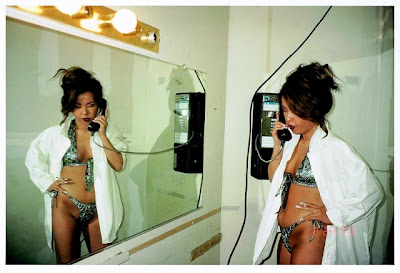
Nikki S. Lee
The Exotic Dancers Project (31), 2000
Fujiflex
30 x 40 inches
76.2 x 101.6 cm
Edition 1/3


Ariana Page Russell
"Morning Glory"
Archival inkjet print
26" x 18"
2009


ARTmostfierce is not missing this one!
This group show pushes, explores, raises new questions and boundaries about what Photography is today and that is why, I find it highly collectable and worth learning about. 
 Just with the work of  artists like  Nikki Lee & Ariana Page Russell alone there is plenty to go around. Congratulations to Lisa Schroeder & Sara Jo Romero  for such effort, see their press release below and see you Friday 5/22/09 at the opening!

Schroeder Romero is pleased to announce Deviate, a group exhibition featuring works by artists who are altering materials and repurposing objects that prompts viewers to investigate the act of looking and perceiving. The artists in Deviate tend to focus on the conceptual and physical properties of ordinary materials, in some cases even their own bodies, exploiting or manipulating them to achieve a certain vision.


Ivin Ballen composes maquettes of commonplace items and then casts fiberglass and aqua resin sculptures of their negative space. He then paints with acrylic and watercolor with trompe l'oeil effects that reference the original found objects.


Sebastiaan Bremer blankets his photographs with ink dots that create a screen effect over the image beneath which compels the viewer to look at, and through, the hand-drawn surface to see the complete image. Neither the dots nor the photographic images ever fully describe, demonstrating Bremer’s central philosophical observation that all apprehension is necessarily subjective and incomplete.


With the precision of a surgeon, Brian Dettmer uses tweezers, scalpels and other medical instruments to alter books by carving out and exposing selected images and text to create intricate three-dimensional works that reveal alternative interpretations of the books.


Jim Dingilian uses candle smoke to create drawings inside glass bottles that depict suburban fringe areas such as the edges of parking lots, the backs of shopping centers, and patches of woods between housing developments. The ubiquity of these locales and their ambiguity -- simultaneously everywhere and nowhere -- make them areas of great potential and they take on new meaning through the viewer's eyes.


Richard Klein's sculptures convert transparent media, such as eyeglass and sunglass lenses, bottles, and liquid into prismatic passageways refracting ambient light, casting it out in shimmering patterns on the surrounding architecture. His work transforms light into something intangible and invests his sculptures with a less-objective, abstract component.


In her Projects series, Nikki S. Lee infiltrated particular subcultures and ethnic groups and after spending several weeks participating in the group's routine activities, she photographed herself with these groups. Lee's projects propose questions regarding identity and social behavior. Lee believes that "essentially life itself is a performance. When we change our clothes to alter our appearance, the real act is the transformation of our way of expression - the outward expression of our psyche."


Using her skin as her canvas, Ariana Page Russell creates a series of "tattoos" to adorn her own body. The source of these "tattoos" is unique; the artist has a skin condition called dermatographia in which painless scratching on her skin’s surface creates red welts that remain for about 30 minutes. Russell photographs herself before the welts disappear. Rather than hiding behind her condition, Russell is empowered by it. She puts herself in front of the camera playing with ideas of fashion and concepts of beauty, what she terms “the bloom of adornment.”


At first glance, many of Devorah Sperber's installations appear to be abstract fields composed of spools of thread. However, upon a closer look through a clear acrylic viewing sphere, the thread spool "pixels" develop into recognizable images. While many contemporary artists use digital technology to add complexity to their work, Sperber aims to humble technology through the use of mundane materials such as spools of thread and chenille stems, (pipe cleaners), which are then assembled with low-tech, labor-intensive processes creating works that challenge the way we interact with the world.


In his Best of... series Richard Thatcher plays with the position of Artforum Magazine as an appealing container of slick advertisements and pronouncements of the very best of the year's art production. The magazine is screwed down and sealed away in a handsome industrial package rendering the magazine unreadable.

Sebastiaan Bremer
Jump Into the Fire, 2008.
Inks on C-Print,15.75 x 23.5 inches


Jim Dingilian
Deep Down, 2008
Smoke inside empty glass bottle
10 ½ x 2 ½ x 2 ½ inches


SCHROEDER ROMERO
637 West 27th Street New York, NY 10001
tel: 212 630-0722 www.schroederromero.com
tuesday-saturday 11-6

Monday, May 18, 2009

ARTmostfierce AFFORDABLE PRINT Pick of the week

BRIAN ULRICH
Gurnee, IL
2005; from the series Copia; archival pigment print, 11 x 14." Edition of 20.
Collector Level Membership: $350


This week  Artmostfierce Affordable Print of the week goes to a limited edition print released by SF Cameraworks by extraordinaire photographer, friend and new Guggenheim Fellowship recipient, Brian Ulrich.

From his famous Copia series this print tilted Gurnee, Il. is only a  limited edition of 20  and come on folks only $350.00 USD. This one is a must buy and have...I already got mine so...go and get yours. Remember only 20 available and I know some friends who already made a move on it! 
 

Stay tuned for an interview with Brian Ulrich coinciding with his next solo show at Julie Saul Gallery opening May 28, 2009.

http://www.sfcamerawork.org/getinvolved/membership/prints.php
www.notifbutwhen.com/

Sunday, May 17, 2009

NY PHOTO FESTIVAL 2009 Round #3


Shocking? You should see the rest of this show!


The Zombies series of Bruce Labruce


Photo- work by Slava Mogutin


Photos- The work of Karol Radziszweski


More Highlights from the NY Photo Festival .

 This show included work of both known and non-professional photographers, that explored the relationship between photography and SOME specific  sector of  the  Gay culture in the 20th century. Some highlights were Stefan Ruiz’s portrait work  San Francisco Berlin  and an installation by Christopher Clary of photos off of gay social networking sites. 

Curated by Chris Boot, Gay Men Play is an exhibition that makes quite a statement. Art is supposed sometimes to shock, provoke, react, scare and maybe offend but, that is why Art is considered art and liked by some and disliked by others .

Nowadays there is a lot freedom in society and the Internet has generated new outlets for people of all walks of life including gay men to branch out their network and live out their most intimate fantasies in front of a computer.

At a time of which another sector of the Gay Community is trying to tear down another barrier, this time GAY Marriage , here comes this show with a strong and in your face message far...way too away from family values. Was it my favorite show at the NY Photo Festival? ...No. Does it have documentary value,purpose and there is talent in it? Absolutely YES!

Does it worry me as gay man being perceived as part of this lifestyle that most gay men feel like they need to endure to be part of a community ( these days we are bordering mainstream lets face it, gays nowadays  we can live almost everywhere...no?) ? Hell Yeah!

Does it bother me that after so many years of donating money and volunteering tirelessly for AIDS organizations, some of those on line, are  friends of mine (still alive thanks to all my efforts) being  the firsts Pariahs behind a computer still looking for quick sex, drugs and I hope not infecting others? Hell Yeah!

All these questions and more came to mind while observing this show. The Gay Men Play show works in so many levels mostly because it highlights one of the biggest issues that prevails and stereotypes gay men in society... some GAY MEN STILL PLAY and hope it is SAFE!

The portraiture work of Stefan Ruiz is honest and it has a degree of sophistication to some extent. To me, it has documentary value and it demonstrates that we live in a free society in which people are able to express themselves with its appearance and live out its fantasies to its fullest. 


Aperture Presents “Photography After Frank” panel discussion with Philip Gefter and Andy Grundberg


Author Philip Gefter and Andy Grundberg


This was a great talk but, it left me wanting more. I  really wished it would it lasted longer. Maybe next year, some talks can be extended to 1 1/2 hours. This talk in particular could it use the time. The period that covers the book Photography after Frank is about 50 years of photography and there is way too many photographers and works covering that period.  Philip Getfer, the author had so much to say and could not get pass the period of Cindy Sherman (70's) and Gregory Crewdson. 

I was hoping to hear about Ryan McGinley and most recent stars of photography. Oh well ...next time and next Photo festival . I must admit that the talk worked in so many levels because NOW... I really want to buy the book to get all the facts. So like me, I encourage you to buy this book . based on this good panel discussion, the book  Photography after Frank it is a must have! 


 Ok folks, I did my best , battled allergies , asthma , partied, commuted from Manhattan to Brooklyn and hope that my efforts paid off in giving you an idea, commentary, highlights and photos of  what the NY Photo Festival 09 was like. Till next year! 

(Super) Natural NY Photo Festival Satellite Show @ the Tobacco Factory


Photo-Hannah Whitaker, Greenbottle Blue, 2007


Photo- Charles Atherton, The Barn ,2008


This was one of the best curated group  shows of the NY Photo Festival. A great selection of works and talent. In addition a great catalogue/book was put together by Adoramapix Photo books of the show which, I think is worth getting one. Great pieces by Hannah Withaker, Charles Atherton, Matthew Porter and Sarah Palmer among many.

(super)natural is a group show featuring work that engages with and re-imagines the idea of nature and natural phenomena. From large format landscape photography to site-specific installation, the work on view makes visible the awesome and terrifying aspect of the sublime in nature.

LUCI, a curatorial collective based in NYC, presents a diverse group of artists and photographers including Charles Atherton, Christoph Bangert, Marla Leigh Caplan, John Clang, Theresa Ganz, Justin Hollar, Rachel Hulin, Christopher LaMarca, Arthur Ou, Sarah Palmer, Matthew Porter, Victoria Sambunaris, Willamain Somma, Kate Steciw, Hannah Whitaker, Troy Williams and Jeff Whetstone.

Exhibition Sponsored by: Adoramapix + Splashlight studios.
http://www.mzhphoto.com/luci/

Saturday, May 16, 2009

The Edge of Vision: Abstraction in Contemporary Photography Opening @ Aperture Foundation 5/16/09

Artist Silvio Wolf in front of one of his abstract masterpieces


Aperture Foundation-Yseult Chehata


Aperture Foundation- Kellie McLaughlin


Curator Rene Abdo and Art Collector Cesar Llacuna in front of Charles Lindsay's Carbon


Great opening!

Over 1,000.00 people attended  tonight this show opening!

A big hit for Aperture Foundation right in the middle of the NY Photo Festival . A bold move but, with great results.I myself was getting tired of heading to Brooklyn for the past days so, this opening party was a breath of fresh air. The crowd was mostly art curators,dealers, collectors, publishers, established artists and photographers.A crowd just as good, if not better than the NY Photo Festival parties.Everybody was seriously interested in the exhibit in which most of the pieces were pretty interesting visually and different in technique and content.

See more info below and go and see it!

Also there is a limited edition portfolio and a book worth investing on!

http://www.aperture.org/gallery/

Curated by Lyle Rexer

Bill Armstrong, Carel Balth, Adam Broomberg and Oliver Chanarin, Ellen Carey, Roland Fischer, Michael Flomen, Manuel Geerinck, Shirine Gill, Barbara Kasten, Seth Lambert, Charles Lindsay, Edward Mapplethorpe, Chris McCaw, Roger Newton, Jack Sal, Penelope Umbrico, Randy West, Silvio Wolf,
Ilan Wolf

Friday, May 15, 2009

ARTmostfierce Photos on display @ NY Photo Festival


Yes folks, I do buy, collect, promote, blog about, curate on shows and consult about everybody elses photos most of my time, leaving barely anytime for my own.

 So, I submitted at the very last minute 12 of my own photos to the NY Photo Festival WE ARE ALL PHOTOGRAPHERS NOW and they were chosen and are on display!
Here is the e-mail received about it:

Dear Photographer,

Congratulations! Your images were shown at the NYPH ’09 festival yesterday. Enclosed you will find installation views of your images as they appeared on the festival’s screen.

The festival is enjoying great crowds. The organisers are all grateful for your participation in this global project. Thank you again for enriching the visual experience of festival goers.

Sincerely,

William A. Ewing
Curator
New York Photo Festival ‘09
Director, Musée de l’Elysée, Lausanne


See below a sample of a few of them at the installation. See the original photos below.


Thursday, May 14, 2009

More highlights from The NY PHOTO Festival

Photos- Venetia Dearden- Great photo series!


Photos by Seba Curtis


Photos by Louie Palu


FOTO8
At Foto8 HOME FOR GOOD curated by Jon Levy, the works of Veneta Dearden, Seba Kurtis and Louie Palu were among my favorites.

www.foto8.com/summershow

NY PHOTO FESTIVAL 2009 Round #2

Photographer Edith Maybin


Photo-Edith Maybin-From The Temby Document Series


Another busy day with 3 talks , 3 shows and of course another party!
The first talk was with Photographer Edith Maybin whose work is being shown @St Ann Warehouse. The talk was pretty good and the subject of most of her work is her daughter.Edith Maybin investigates the space between mother and daughter. She takes portraits in a home environment where she and her daughter enact secret stories together whist wearing Marks and Spencer undergarments, a gesture towards Maybin’s own mother and an investigation into female rituals and sentimental inheritance. The photos are beautiful!

However, my favorite series is The Conversion Document and in particular the photo below

Photo-Edith Maybin-From The Conversion Document Series

http://edithmaybin.com

Architect Renzo Piano Embraces Chicago

The new $294 million addition to the Art Institute of Chicago.


This is worth reading and a trip to Chicago is in order!

I can't not wait to see this anex for the Art Institute of Chicago designed by the greatest Architect , Renzo Piano. Please read architectural review by NY Times Nicolai Ouroussoff. ARTmostfierce is on is way to round two of The NY Photo Festival.There is also a link of an art review by Roberta Smith about this new building interior.
Enjoy!
http://www.nytimes.com/2009/05/14/arts/design/14inst.html?th&emc=th
http://www.nytimes.com/2009/05/14/arts/design/14muse.html?th&emc=th

By NICOLAI OUROUSSOF
Published: May 13, 2009
CHICAGO — America has been suffering from Renzo Piano fatigue.


For years Mr. Piano seemed to be snapping up all the best commissions: the renovation of the Morgan Library & Museum in Manhattan, a science center in San Francisco and museum additions in Los Angeles, Boston, Chicago and Fort Worth. (He even designed The New York Times Building.)

Many of his peers gripe that this is because of the subdued nature of his designs — sophisticated but not too threatening or unfamiliar — which seem tailored to ease the insecurities of museum boards. Some envy his elegance, which makes him seem equally at home in corporate boardrooms and lofty cultural circles.

It’s hard to know how these qualities will play out amid the gloom and doom of the new economy. In some ways Mr. Piano’s refined, risk-averse architecture may be more appealing than ever. He is not out to start a revolution. His designs are about tranquillity, not conflict. The serenity of his best buildings can almost make you believe that we live in a civilized world.

The new $294 million Modern Wing of the Art Institute of Chicago, which opens on Saturday, is the closest Mr. Piano has come in at least a decade to achieving this near-classical ideal. Its delicate structural frame is a sparkling counterpart to the museum’s 1893 Beaux Arts building. The light-filled galleries show the Art Institute’s marvelous collections of postwar and contemporary art in their full glory, including many works that have been buried in storage for decades. Most of all, the addition manages to weave the various strands of Chicago’s rich architectural history into a cohesive vision, one that is made more beautiful by its remarkable fragility.

The 264,000-square-foot wing is the largest expansion in the museum’s 130-year history. The addition stands behind the original building, across a set of commuter railroad tracks. The two structures are joined by a small gallery building from 1916 that bridges the tracks. Millennium Park, its far end punctuated by the swirling steel forms of Frank Gehry’s band shell, extends to the north.

Seen from the park Mr. Piano’s structure immediately brings to mind the work of Mies van der Rohe, a pillar of modern architecture who moved to Chicago from Germany in the 1930s. The taut forms and refined details, the elevation of an industrial aesthetic to an art form — all are hallmarks of Mies’s work. Mr. Piano’s towering glass-and-steel facade, with its floating roof and excruciatingly slender columns, even evokes a lighter, more ethereal incarnation of Mies’s 1968 Neue Nationalgalerie in Berlin, a landmark of 20th-century design.

Mr. Piano carefully knits these forms into the surrounding fabric. The addition’s main entry hall is parallel to the tracks, so that their grittiness becomes part of the overall composition. A series of heavy walls that frame the entry are made of limestone to match the original building. A long, slender bridge, one of the design’s most whimsical features, connects the addition to the park across the street.

The play between Modern and classical themes continues inside. The entry hall, a long towering space enclosed beneath a glittering glass roof, could be a contemporary version of a cathedral, designed for the worship of art. Its elongated form is used to draw you into the building. From there people turn and look out at a grassy outdoor court before climbing a staircase to the main galleries. The staircase, suspended on slender rods, was inspired by Mies’s design for the Arts Club of Chicago.

Some will feel that the journey from the front door to the art is too drawn out, but it gives you the impression of having ascended to “a sacred space.” Occasionally Mr. Piano’s galleries can be too precious: the level of refinement gives them a cool, almost sterile feel. But these rank among his best. The rooms are beautifully proportioned. A thin steel border frames the plaster walls, giving them a clean industrial look.

Mr. Piano also seems to have created the right amount of intimacy between art and viewer, without completely shutting out the world. Floor-to-ceiling windows overlook the park and courtyard from some galleries. The windows are covered with white screens, lending the views a soft, ghostlike quality. This effect is reinforced by the layering of glass, which shuts out street noise and gives the sight of people walking below a particularly eerie, cinematic quality.

But it is the light that most people will notice. Mr. Piano has been slowly refining his lighting systems since the mid-1980s, when he completed his design for the Menil Collection building in Houston. Over the years these efforts have taken on a quasi-religious aura, with curators and museum directors analyzing the light in his galleries like priests dissecting holy texts.

At the Art Institute Mr. Piano has stripped the system down to its essence. The glass roof of the top-floor galleries is supported on delicate steel trusses. Rows of white blades rest on top of the trusses to filter out strong southern light; thin fabric panels soften the view from below.

The idea is to make you aware of the shifts in daylight — over the course of a visit, from one season to another — without distracting you from the artwork, and the effect is magical. On a clear afternoon you can catch faint glimpses through the structural frame of clouds drifting by overhead. But most of the time the art takes center stage, everything else fading quietly into the background.

It is this obsessive refinement that raises Mr. Piano’s best architecture to the level of art. In an age with few idealists, he exudes a touching faith in the value of slow, incremental progress. He has never fully abandoned the belief that machines can elevate as well as destroy.

The beauty of his designs stems from his stubborn insistence that the placement of a column or a window, when done with enough patience and care, brings us a step closer to a more enlightened society.


In Defense of Calatrava’s World Trade Center Hub

You got to watch this!

Santiago Calatrabra magnificent design for the new World Trade Center Station... the very same one I made out alive during the attacks on September 11, 2001.